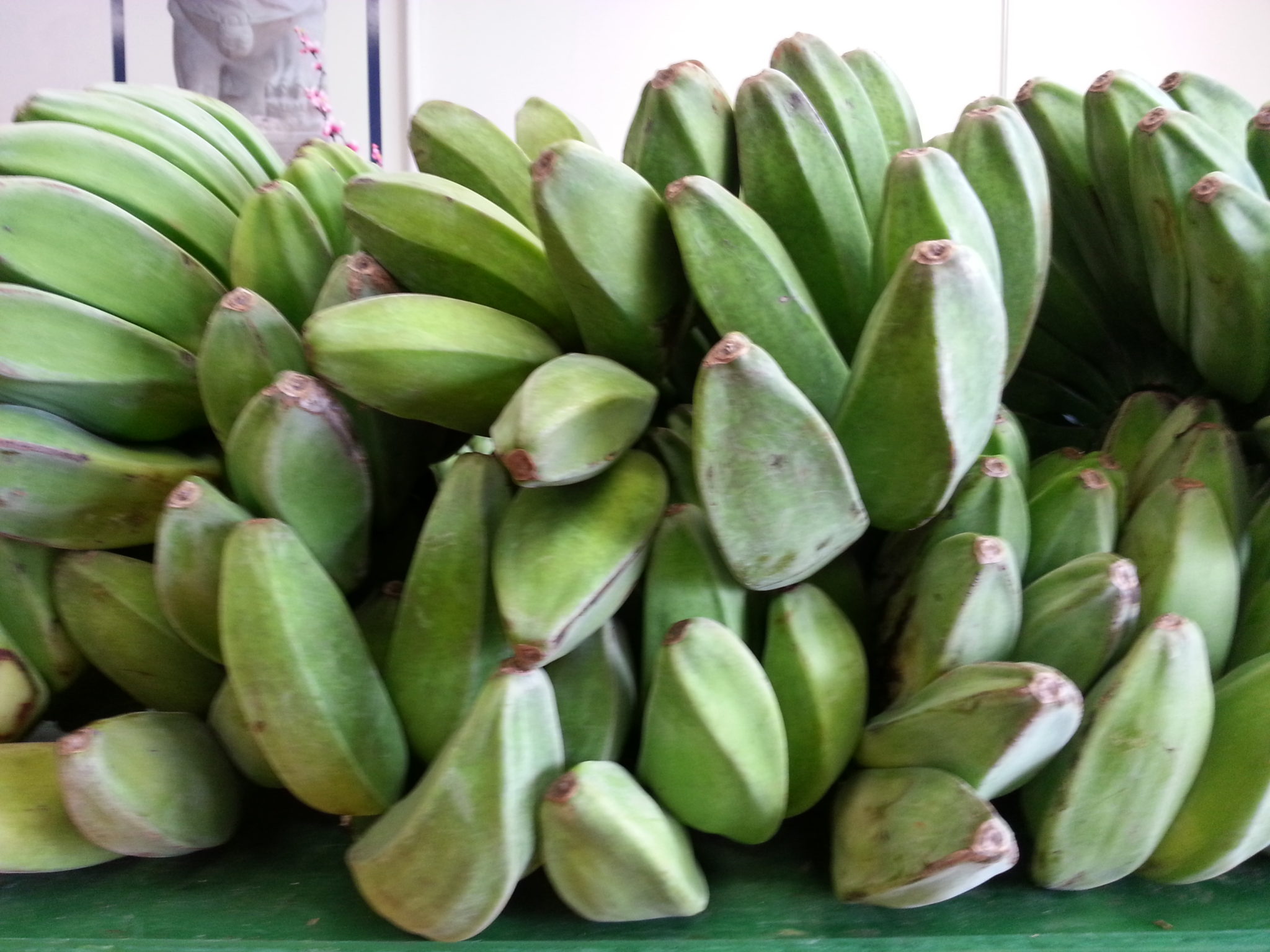
Green “Saba” Banana

Green  Saba Banana

Green “saba” banana or commonly called plantain is very common in the Philippines as a snack food. I grew up practically eating this type of banana. It has more starch than sugar compared to other bananas like apple bananas for example. That’s why when you eat this raw, even if its ripe, it’s not as sweet as the other bananas. That’s why we cook this type of banana. During my elementary school years, I always eat this “saba” banana during recess. It is boiled in water and brown sugar and when they serve it, they put shaved ice and cream on top. I tell you, it’s really, really good.

“Saba” bananas also is made into what we call banana cue which means bananas in skewer. The ripe bananas are fried in oil then brown sugar is added until it caramelized and coats the bananas. Then they are sold in bamboo sticks and so they are called banana cue like barbecue in sticks. It is also an ingredient in making halo-halo, bilo-bilo and other delightful desserts. But sometimes they are used in savory cooking like beef nilaga and estofado. Other places in the Philippines like in Iloilo or Kalibo in the Visayas, the green saba banana is boiled and eaten just like a regular potato. They also make banana chips that are coated with caramel and sold as snacks too. I understand that other cultures use plantain as staple foods especially in Africa. In Central America and the Caribbean, it is used in practically every dish.

Just like the common banana, saba or cooking banana is also rich in potassium and low in calorie. The tree of the saba banana (Cardaba banana) is easy to grow and propagate by itself. When the fruits are ready to pick, you have to chop the whole tree because it will die anyway eventually since it has done its job which is to bear fruit.

Similar Posts

  • Kamias

      Kamias – Averrhoa bilimbi – also known as cucumber tree or tree sorrel is a very common fruit in the Philippines used as a condiment.  It is a fruit but it is so sour it is used mostly for cooking.  The kamias is like the tamarind, used in making sour-soup or sinigang. We used…

  • Coconuts

    Coconuts when eaten fresh and young is considered as a refreshment when I was growing up in the Philippines. We drink the water inside the coconut and then by cutting the coconut in half, the white flesh will be revealed and that’s very good to eat indeed. The mature ones are utilized as a culinary…

  • |

    Kamansi

      Kamansi also known as breadnut  (bot. name- Artocarpus camansi – blanco) is a relative of breadfruit and jack fruit.  The breadfruit has more pulp and small seeds while the kamansi has bigger seeds and less pulp and  just like the  jack fruit, the seeds are edible and can be boiled or roasted and a…

  • |

    Jackfruit

    We call the jackfruit “langka” in the Philippines.  I consider it as the biggest fruit ever.  When I was young, we  nicknamed it “hog” because sometimes it grows as big as a pig.   I remember my grandma’s jackfruit tree in the farm and the fruit almost touches the ground.  I also remember eating the fruits…

  • Star Fruit

    Starfruit also known as carambola is native to the Philippines, and the botanical name is “Averrhoa carambola. We call it “Balimbing” which is an ambiguation from the botanical name of another fruit we call “kamias” or Averrhoa bilimbi which is sour and used as a souring agent for soups and other dishes. The fruit has…

  • Surinam Cherries

    I don’t know much about Surinam Cherries. I just happen to see these beautifully colored fruits in my neighbor’s yard and I took a picture of it. It also inspired me to do a painting of it. I believe I blogged that painting last February. Since I only knew little about this fruit I did…