Coconuts/Niyog

Coconut is the most versatile of all plants that I ever knew. From the fruits, to the leaves, to the trunk almost all parts of it can be used for something.
The leaves we used for wrapping a delicacy we call “suman” (glutinous rice wrapped in coconut leaves). The inner part of the leaves is gathered and made into a broomstick for sweeping the yard. The trunk is now utilized as the “new wood” in making furnitures and in building houses.
Best of all is the fruit. Young coconuts are used for refreshments. The mature ones are used for making the coconut milk we’re all familiar with. It is also the source of coconut oil (copra industry) where it is manufactured as cooking oil and soap, etc. The husks from the coconuts are now also used in making coir which can be formed into rugs, or in the garden as liner for hanging baskets. The rest can be burned for firewood.
So many things I want to write about coconuts I even painted them as my tribute to the most versatile plant in the world, I think.
Similar Posts

  • Buko/Young Coconut

    Young coconut or “buko” as we call it in the Philippines is gaining popularity nowadays. It might as well be because researches are always coming up with good news about it, how it is good for you.  The list of nutritional benefits goes on and on. I’m happy that I grow up enjoying young coconuts. …

  • Macopa/Mountain Apple

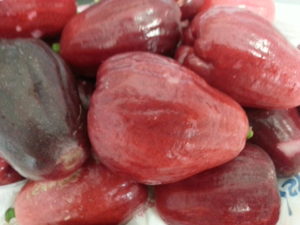
    Macopa or Mountain Apples are in season now in Hawaii and they look delicious. Their red color make them almost look like red delicious apples. They are crunchy and succulent and although not too sweet, they are refreshing to eat. Each fruit have a seed inside which you can discard because they are not edible.

  • Atemoya/Cherimoya

    Atemoya is a hybrid of two types of annona fruits which are sugar apple and the cherimoya.  The sugar apple is what we refer to in the Philippines as “atis” the word I believe came from the old Mexican word “Ate” which refers to sugar apple.  The crossing of these two types of  Annona fruits…

  • Guava

    Guava is a popular fruit in the Philippines but it is seasonal. During rainy season that’s when it is most abundant. There are several varieties of guava that is native to the Philippines that I know of but the guava java which is an import variety from Indonesia hence the name, became the most popular….

  • Guava

    Guava (Psidium Guajava) is a tropical fruit native to Mexico, Central America and the northern part of South America and is called guayaba, a Spanish word which the Filipinos used and became “bayabas” in the native dialect. The tree can be grown from seeds, and will start fruiting within 2-4 years. It will produce fruits…