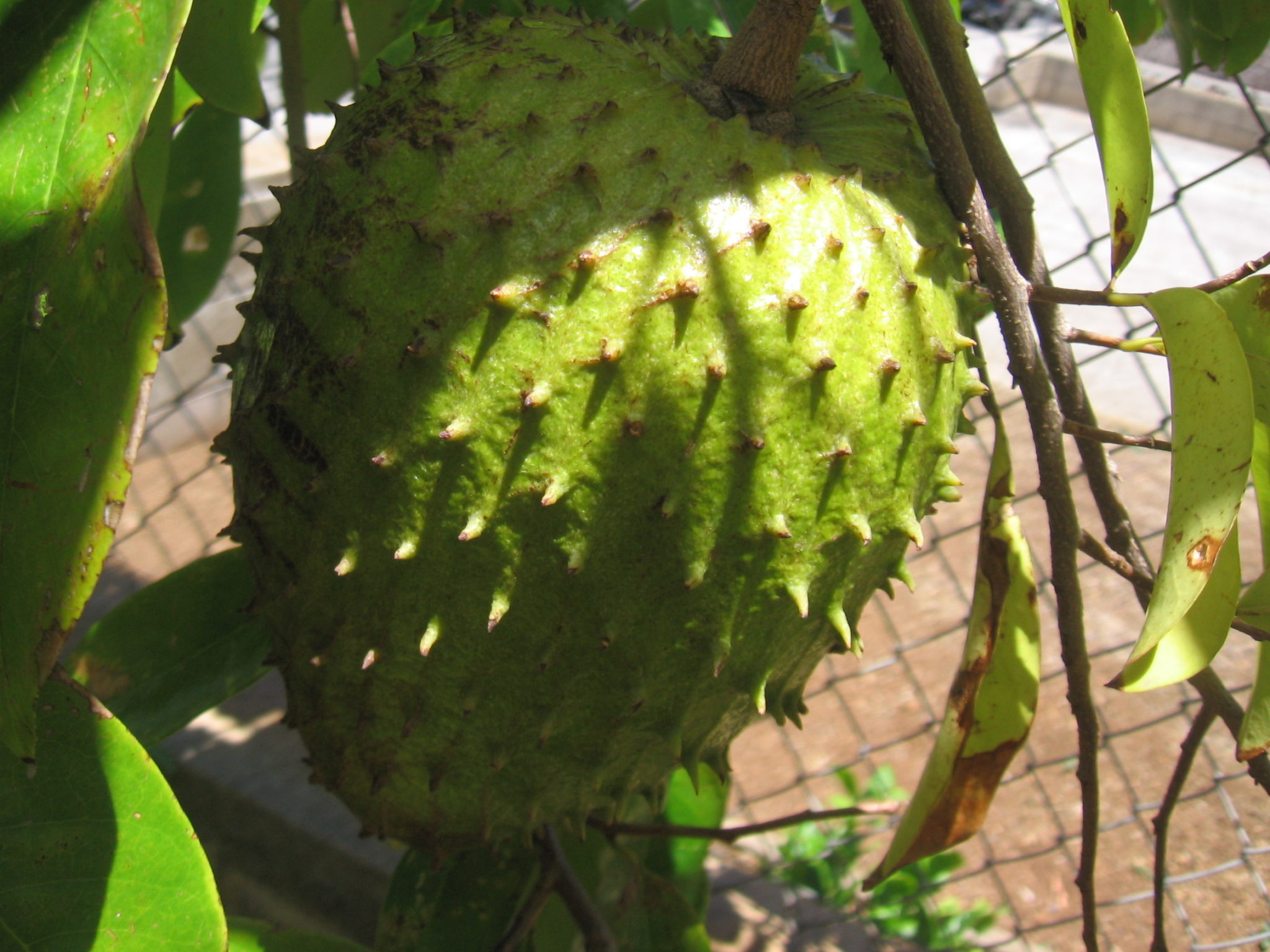
Soursop/Guyabano

Jamie's Bapt. 812 029

Soursop or guyabano as we call it in the Philippines is gaining popularity as a health fruit and a natural medicine against cancer.  Whether it is true or not, soursop or guyabano is an interesting fruit to eat.  The skin looks like it would hurt you when you touch it but the spikes you see are soft to the touch. When you open it, the flesh is white and have sheath like custard tasting meat with a combined sour and sweet taste at the same time.  The sections of the fruit has some brown sometimes black seeds. The leaves which are dark green and glossy are also considered as medicinal.  The leaves are boiled and taken as tea to relieve stomach problems, to reduce fever, and other ailments.

Soursop or Annona muricata is an evergreen tree native to Central Americas, Mexico, Cuba and the Caribbean and in South American countries like Colombia, Brazil, Peru, Ecuador and they call it guanabana. I guess that’s where we got the name guyabano. The leaves are green and glossy. The flowers are so fragrant when opening up and I remember when I was a kid being beaten by fire ants which always make the soursop tree their home.

Soursop is being sold now as a smoothie drink in Chinatown. The white pulp is also made into ice cream.  In the Philippines, it is sold as a drink in tetrapaks. It is good to eat it fresh though.  You will know that it is ripe and ready to eat if the fruit yields by touch just like an avocado.  It not only tastes good but it has all kinds of Vitamins like C, and B and also dietary fibers which are good for you. Anti-cancer or not I don’t mind eating this fruit everyday as a healthy regimen.


Similar Posts

  • Surinam Cherry

    Surinam Cherry – Eugenia uniflora – also called Pitanga is native to South America and made its way to Hawaii and is also considered an invasive plant. It grows easily and is also pest resistant. The birds like to eat them and spread the seeds by their droppings. Surinam Cherry is a small tree that…

  • |

    Jackfruit

    We call the jackfruit “langka” in the Philippines.  I consider it as the biggest fruit ever.  When I was young, we  nicknamed it “hog” because sometimes it grows as big as a pig.   I remember my grandma’s jackfruit tree in the farm and the fruit almost touches the ground.  I also remember eating the fruits…

  • Pomegranate

    Pomegranate – Punica Granatum is gaining popularity in the culinary world.  It’s uses in garnishes and juices are almost an every day scene around the culinary world now.

  • Calamansi/Calamondin

    Calamansi or calamondin – (citrofortunella) is our lemon counterpart  in the Philippines. It is a fruit but is more widely use as a condiment.  It is a good accompaniment for pancit or rice noodles, rice porridge or arroz caldo and also can be juiced for a refreshing drink.  It is sometimes used in “sinigang” or…

  • Green “Saba” Banana

    Green “saba” banana or commonly called plantain is very common in the Philippines as a snack food. I grew up practically eating this type of banana. It has more starch than sugar compared to other bananas like apple bananas for example. That’s why when you eat this raw, even if its ripe, it’s not as…

  • Cashew Fruits

    Cashew nuts are my favorite snack food. I always wish I could eat the fresh roasted nuts from my hometown that I was accustomed to. Eating the fresh roasted cashew nuts is really a treat. It always remind me when I was a young kid, playing with the raw nuts as jackstones and then roasting…