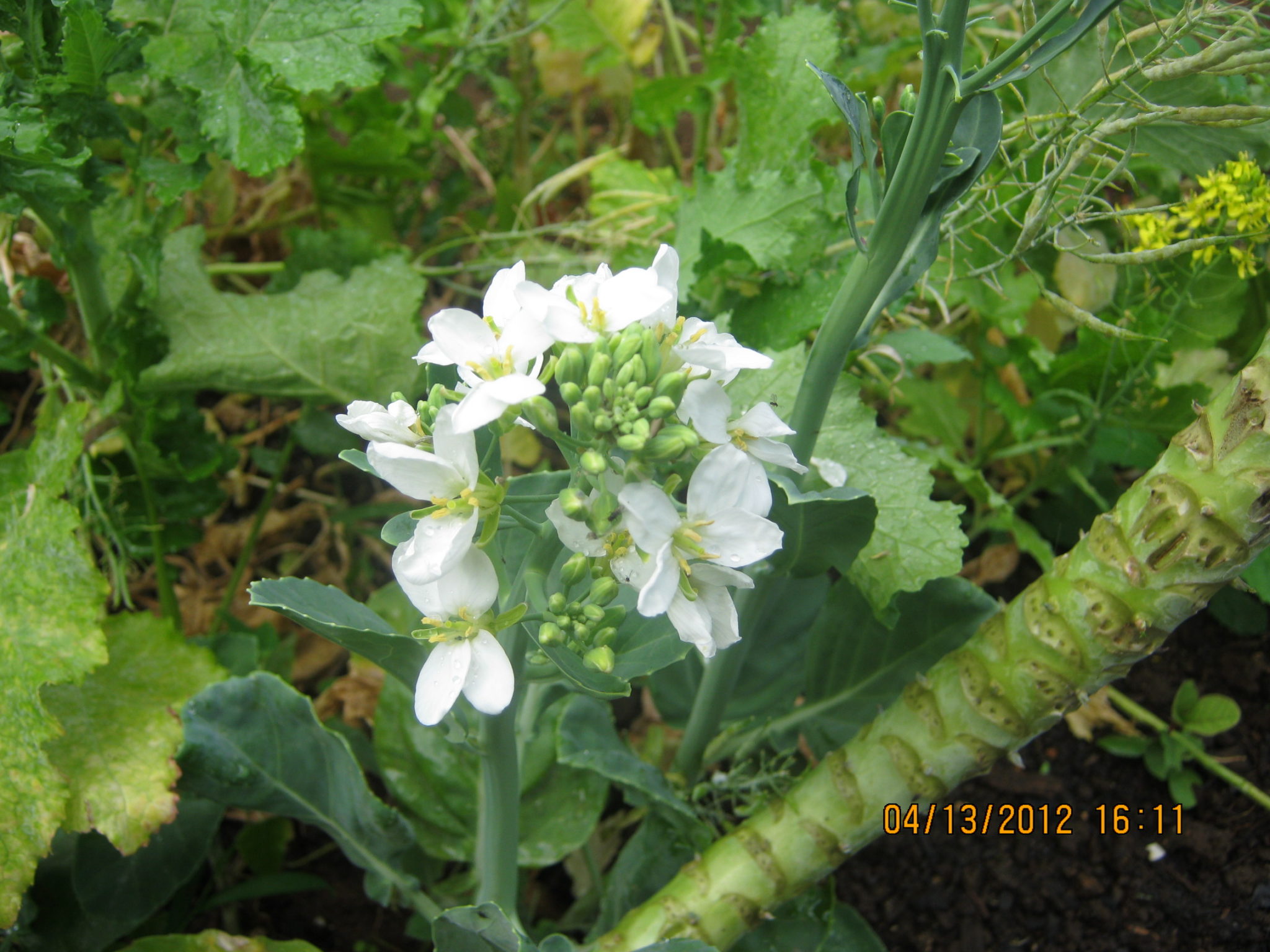
Chinese Broccoli

Chinese Broccoli also known as Kai-lan or Gai-lan is one of my favorite vegetable to grow. It is also my favorite vegetable to stir-fry. I first encountered these delectable leafy vegetable when I traveled to Hongkong a decade or so ago. Most of the restaurants in Hongkong serve these delicious leafy greens mixed with meat, chicken or seafood. They are simply prepared but so good just the same and they are reasonably priced too. You can eat your heart out in Hongkong without breaking the bank or your wallet.
Chinese Broccoli is a leafy vegetable greyish- blue in color and have thick stems just like the regular broccoli. It will develop florets that would open into a bouquet of white flowers which the bees love. Planting is not difficult. The soil must be amended with compost and manure. You can sow the seeds directly into the prepared bed. I would dug up a trench then sow the seeds and cover with soil lightly. I would then cover the bed with window screen to protect the seeds from the birds before watering. Keep the soil moist during the entire growing season. Harvest them before the flower form.
Chinese Broccoli is also nutritious. It has Vitamins K, C, A, B-vitamins especially Folic Acid and Minerals like potassium, manganese, zinc and calcium.
Just like its cousin the Choi-sum, you can steam the leaves then add oyster sauce and fresh garlic or you can stir-fry it with other vegetables like green bell pepper, celery and carrots with tofu for vegetarians or with beef or chicken. For beef I always use top sirloin because it is tender than other cuts. For chicken, you may use breast or thighs, they are both good.
Chinese broccoli is in the family of Brassicas (broccoli, cabbage, kale are some of them) which are well-known to be cancer fighters that’s why I grow them. Not only it is tasty, it will help me stay cancer-free.

Similar Posts

  • Bataw/Lablab

    Bataw or Lablab is a relative of the purple-hyacinth bean. It is a very versatile bean because you can use it in almost all type of cooking that requires beans. I particularly like to cook it stirfry with pork and shrimp. It takes a while before the seeds germinate after sowing but when it does…

  • Cucumber Flowers

    After a week or so, I’ve been seeing cucumber flowers. I can’t wait to see what it looks like. That’s why it’s important that you label your seedlings to know what variety it is. In this case, I don’t know because a friend of mine just gave me the seeds. Anyways, pollination is important, so…

  • Cucumber/Poona Kheera

    Cucumber or pipino as we call it in the Philippines is my favorite salad vegetable. I also make pickle out of it. But I really don’t have luck in growing cucumbers. Last month, a friend of mine gave me some seeds which he said came from Sri Lanka. I immediately planted it and see how…

  • Upo

    Upo or Long gourd (Lagenaria Siceraria) belongs to the family of cucurbits.  The gourd had been used primarily as a water container.  There are different shapes and sizes to choose from.  Cucuzzi is an Italian long gourd that also belongs to the same family.  Some are long and gnarly that they call it snake gourd. …

  • Watercress

    Watercress is in the family of Brassicas like radish and mustard relating to their peppery flavor. It closely resembles the taste of nasturtiums and the name is the same but they are actually distant relatives and they are easy to grow. Watercress is not available in the Philippines when I was growing up so I…

  • Kohlrabi

    Kohlrabi is in the family of brassicas which includes cabbages, brocolli, cauliflower, kale, collard greens and brussel sprouts. The word kohlrabi is a German word meaning cabbage and turnip. I guess its because it look like a turnip but tastes like a cabbage. I decided to plant Kohlrabi because I was curious about the taste…